
Meet Principal LaKenya Sharpe
After nearly a decade of leading The Collins Academy High School, LaKenya Sharpe continues to positively impact her school’s culture by leveraging her equity-driven approach to student support. Before arriving at Collins, she served as assistant principal at Harvard School of Excellence and Chalmers School of Excellence. She draws on that background to create joyful and structured learning environments, expand career-readiness opportunities, and cultivate a sense of pride and belonging among all of her students.
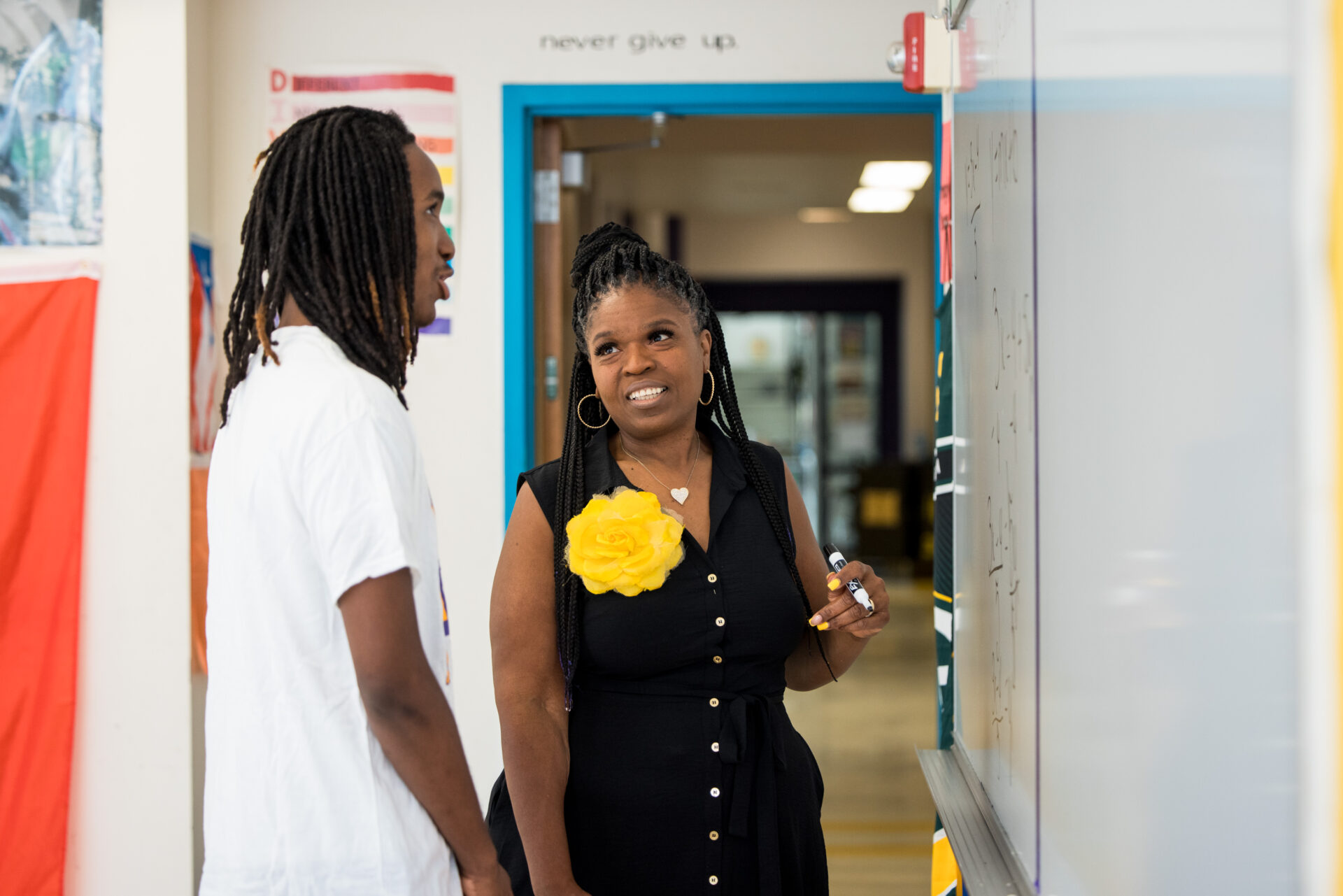
Principal LaKenya Sharpe of Collins Academy High School, 2025
Data-Informed Decision-Making
When Principal Sharpe first arrived at Collins, she noticed troubling patterns in attendance and student motivation, especially during first-period classes. She made it a priority to listen. She spent time in hallways, visited classrooms, and spoke directly with students and staff to better understand what was driving the disengagement. These early conversations revealed deeper barriers like a lack of connection to the school, responsibilities outside the classroom, and a lack of programming to meet student interests — all of which helped shape her next steps.
Implementation & Impact
Principal Sharpe used these insights to inform both school culture and instructional changes. To prioritize student engagement, she launched a series of whole-school activities, such as field trips, including a citywide scavenger hunt using Pokémon GO to foster connection and reframe students’ perceptions of school as a positive, supportive environment.
To address low attendance and behavioral incidents, LaKenya collaborated with her leadership team to develop an incentive system known as Warrior Points, where students earned rewards based on attendance, behavior, and academic performance. Students reaching the top tier gained access to premium field trips, such as outings to Enchanted Castle and Dave & Buster’s.
Principal Sharpe and her leadership team monitored implementation using attendance data, behavior reports, and feedback from teachers and students. As more students reached higher tiers, she scaled the program, expanding the range of trips and incentives. She also introduced public recognition ceremonies and gave out trophies and school ambassador roles to reinforce student effort.
During her early conversations with students, Principal Sharpe also learned that some were responsible for walking younger siblings to school before arriving at Collins, causing frequent tardiness and absences during the first period. Rather than issuing consequences, her team responded with empathy and problem-solving. They built intentional partnerships with neighboring elementary schools, coordinating drop-off windows and communication to support older students in managing family responsibilities without sacrificing their own attendance.
When students expressed interest in cosmetology but found that there was no program at Collins, Principal Sharpe responded by creating an after-school nail technician program, the first of its kind in Chicago Public Schools. She partnered with a local Black-owned salon to provide hands-on training and a pathway to professional licensure.
The results of these innovative shifts were significant. By the end of the year, 40% of students achieved the highest Warrior Points tier, and schoolwide attendance rose by 4 percentage points. Disciplinary incidents declined by 80%.
Principal Sharpe and her team now aim to deepen the Warrior Points program’s academic integration and build teacher-led implementation teams to sustain the work. As she explains, “When kids feel seen and celebrated, they show up for themselves and for each other.”
Apply This Learning
1. Use student voice to guide culture-building efforts.
Principal Sharpe’s approach at Collins began with listening through informal focus groups, hallway check-ins, and direct feedback from students. This practice continues to shape the school’s incentive systems and community-building events. For example, students co-designed elements of the Warrior Points program, voted on field trip destinations, and offered feedback that led to more student-responsive celebrations. These efforts helped students feel seen and valued, which in turn led to increased attendance and participation.
2. Partner creatively to reduce hidden barriers to attendance.
When Principal Collins learned that some students were responsible for walking younger siblings to school before arriving at Collins, she reached beyond her own building and collaborated with nearby elementary schools to enact solutions rather than consequences.
3. Expand access to career pathways through community-based programming.
LaKenya’s decision to start the after-school nail technician program was rooted in student voice. Many shared that college didn’t feel like the right fit for them and that they wanted real, immediate opportunities to build careers. By listening to their aspirations and leveraging local expertise, Principal Sharpe positioned career education as a valid, empowering alternative, one tied to identity, purpose, and tangible outcomes. The program not only affirmed student interests, but also demonstrated that schools can adapt creatively to meet student demand.