
Meet Principal Claudia Ortiz
Claudia Ortiz took the helm as principal of Tarkington Elementary in 2021. She has 25 years of experience in Chicago Public Schools — 17 of them in the classroom — and leads with a deep commitment to equity, multiculturalism, and strong instruction, shaped in part by the fact that she is a first-generation college graduate.
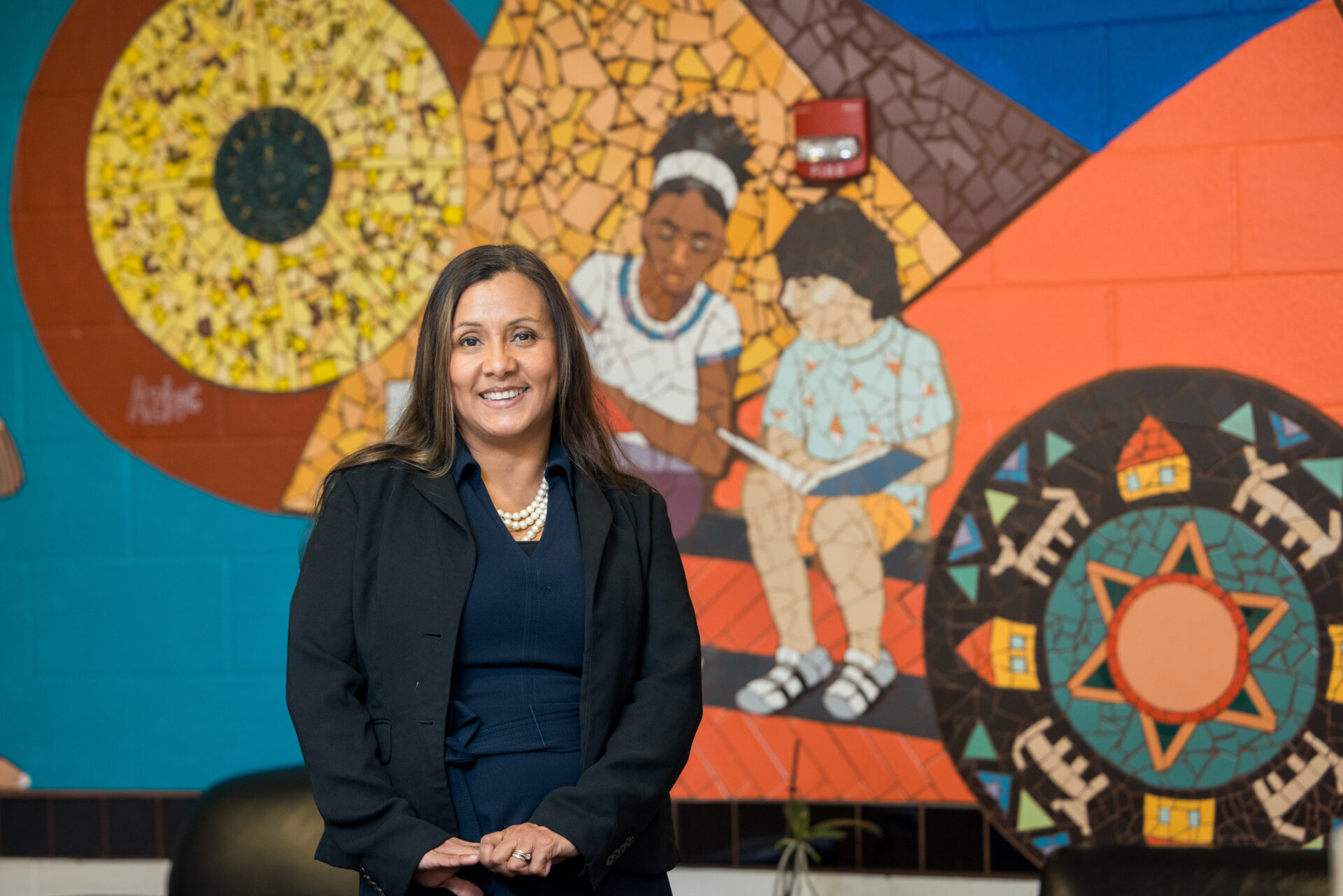
Principal Claudia Ortiz of Tarkington Elementary School, 2025
Student-Centered Opportunity Driven by Data
When students returned to in person learning after the pandemic, Claudia worked to reimagine how Tarkington supported its most impacted students. She recognized that effective transformation had to be grounded in evidence, so she dedicated much of her first year at Tarkington to a rigorous process of data collection to uncover student and staff needs.
Claudia visited classrooms, launched staff surveys, and reviewed student performance data to uncover the most pressing challenges. She saw that English learners and students with disabilities needed the most support, as they were struggling more than their peers with academics, inconsistencies in instruction, and emotional disengagement following the disruptions of the pandemic.
Informed by this data, Claudia worked with her leadership team to clearly identify student needs: stronger teacher-student relationships, more culturally relevant and engaging instructional materials, and an emotionally supportive learning environment. They began changing instructional practices around these findings, embedding social-emotional learning (SEL) into daily routines, facilitating more collaborative teacher planning, and integrating culturally responsive teaching strategies.
Implementation & Impact
In 2021-22, Claudia and her team prioritized rebuilding instructional and behavioral systems at Tarkington Elementary. They adopted Chicago Public Schools’ Skyline English language arts (ELA) curriculum for third through eighth grades and aligned kindergarten through second grade dual-language classrooms with parallel Spanish-language resources to ensure coherence and equity. Teachers used the Illinois Assessment of Readiness (IAR) standards to plan lessons by starting with the end goals in mind. This helped them include high expectations in their everyday teaching.
By the 2022-23 school year, Claudia increasingly distributed leadership through the instructional leadership team (ILT) and a new dual-language ILT. These teacher-led groups met weekly to study the structure of IAR test questions, share teaching strategies through peer-led training, and demonstrate classroom practices that match the format of the IAR. Meanwhile, Tarkington’s multi-tiered system of supports (MTSS) — a schoolwide framework that provides varying levels of academic, behavioral, and social-emotional support based on individual student needs — grew stronger. Claudia hand-selected teachers to lead targeted small-group interventions and intensive, individualized supports designed for students with the greatest academic or behavioral needs based on their instructional strengths and readiness to lead. She strategically elevated in-house educators into interventionist roles, offering coaching and leadership development to expand their impact.
As part of her MTSS strategy, Claudia gradually built the Power of Two initiative, which focused on identifying students whose proficiencies were just below grade level for targeted support and frequent progress checks. Over time, teachers began using Chicago Public Schools’ rigor rubrics and walkthrough tools to provide weekly feedback and participate in peer observations, helping to create a schoolwide culture of continuous improvement. Survey data later showed that over 90% of teachers found the feedback cycles and peer learning to be valuable.
Tarkington’s matched its improved instructional coherence with robust social-emotional support. This included a schoolwide positive behavioral interventions and supports (PBIS) system with monthly student celebrations, confidential mental health counseling partnerships, and a phone-free policy that reduced distractions. Together, these efforts led to fewer behavioral incidents and significantly higher student engagement. Between 2021 and 2024, Tarkington moved from “Targeted Support” to “Commendable” status on the Illinois Report Card.
As Claudia looks ahead, she hopes to deepen teacher leadership across all grade levels and continue refining data-driven supports so that every student is both challenged and prepared for achievement.
Apply This Learning
1. Build coherence through curriculum redesign.
Recognizing gaps in the existing curriculum, Claudia led a schoolwide shift to the Skyline ELA framework, starting with third through eighth grades. For early grades, especially in dual-language classrooms, Claudia secured Spanish-language curriculum materials that mirrored Skyline’s rigor and structure. Today, all students across grade levels receive coherent, high-quality instruction, and teachers use a shared framework and language to plan and assess student learning.
2. Invest in shared leadership and teacher growth.
At Tarkington, teacher voice and leadership are central to school improvement. Claudia nurtured a distributed-leadership model, restructuring the ILT and inviting teachers to lead professional development, model lessons, and even conduct classroom observations using Chicago Public Schools-aligned rubrics. Peer visits became common practice, building trust and a culture of collaboration. Teachers receive weekly feedback on instruction, and many choose to engage in coaching and book studies. Every teacher leader is carefully selected based on interest and readiness to support peers, not just experience alone.
3. Ensure equity through MTSS and SEL support.
Claudia’s vision for equity includes strong academic and social-emotional support systems. Through initiatives like the Power of Two, students just below grade-level proficiency are grouped together to receive extra tutoring from teachers, with their progress closely monitored. At the same time, SEL is embedded throughout the school: The team implemented a PBIS system to recognize and celebrate positive behavior while reducing distractions from cell phones by introducing secure phone lockers.