
At Gary Elementary in Chicago’s Little Village neighborhood, Hispanic Heritage Month doesn’t wait for September. For Principal Alberto Juarez, nearly two decades into leading the school, keeping that culture alive year-round starts with making sure students know who they are.
“Our school is predominantly Latino,” Juarez said. “It’s important not only for them, but for us as well, to ensure that the students maintain their identity, that they know their cultural background, their traditions. Just what makes them who they are.”
According to Fund data, 98.6% of Gary’s students are Hispanic or Latinx, part of the nearly 50% of CPS students who are Latinx, the largest share of any racial or ethnic group in the district.
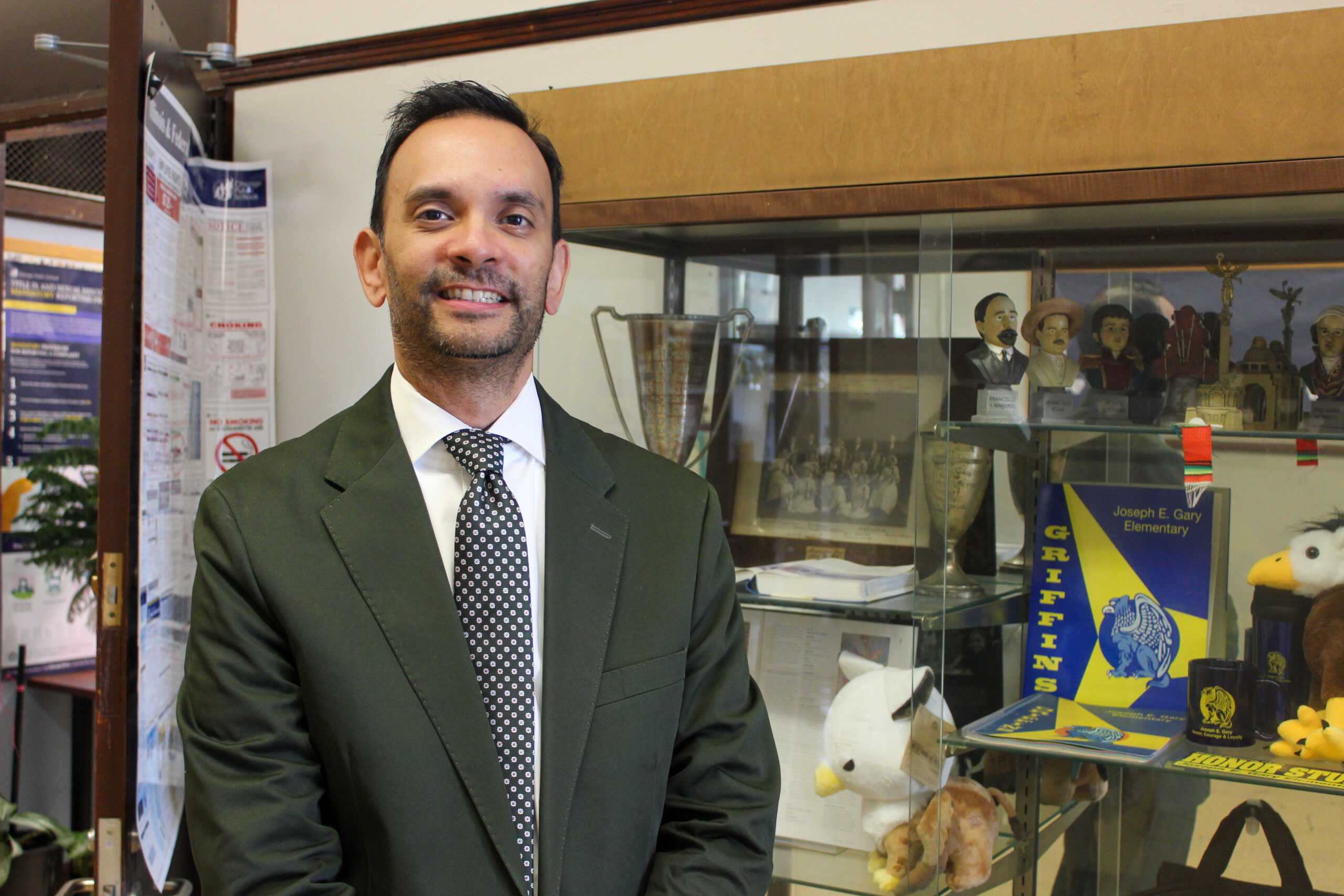
Gary Elementary Principal Alberto Juarez
After nearly two decades as Gary’s principal, Juarez’s tenure is built on a personal connection to the neighborhood that runs as deep as his professional one.
“My parents immigrated here from Mexico with limited schooling,” Juarez said. “To be able to have been a teacher, to now a principal, in a community that represents me, and knowing that we can provide a quality education in this neighborhood, is amazing.”
That community isn’t abstract for Juarez. His own grandson attends Gary, and that representation, he said, matters just as much for students as it does for him.
“It’s very important for our students to see role models, to see someone who looks like them, someone who has walked in their shoes,” he said. “We have great staff who are able to also recount their stories, and share with them that you’re not a victim of your environment. If you really believe in something, you can achieve it.”
Showing Up, Inside and Outside the Building
Juarez describes Little Village as a neighborhood defined by loyalty, one where families return to shop, eat, and get their hair cut at businesses owned by their neighbors, year-round, not just around the holidays.
He’s watched that same spirit shape Gary. When Juarez arrived 19 years ago, the school was on probation; within three years, it was off. Since then, partnerships with the local chamber of commerce, alderman’s office, and organizations like Beyond the Ball have helped build what he calls a safe, nurturing place for students to learn and simply be students.
The results show up in outcomes that families notice directly. According to Juarez, a third of Gary’s eighth graders go on to attend selective-enrollment high schools. “It’s not a dream, it’s a reality,” Juarez said. “You shouldn’t have to go to specific neighborhoods to think that you will get a better education.”
To Juarez, Powering Possibilities for his students means helping students find and use their voice.
“Culturally, we’re taught to just kind of listen, don’t stir the waters,” he said. “We’re trying to define that there’s a way in which we can kind of challenge the norms, but in a very knowledgeable way.” Students at Gary aren’t just invited to raise concerns; they’re asked to come to the table with two or three solutions. “We need a voice, and that’s something we’re working on heavily now within our CIWP: that having a voice is very powerful, but with that comes a great responsibility.”
That work is reflected in Gary’s 2026 5Essentials results, which showed gains of 13 points in quality of student discussion, eight points in school connectedness, and seven points in safety compared to the year before. Juarez credits regular student surveys and focus groups, along with a twice-yearly practice of sharing results directly back with students, for the shift.
“The more we provide our students with opportunities to give input and feedback, the better we can revise our structures and systems, so students feel that this is their school,” he said. This year, Gary was also accepted into the National Equity Project to further deepen that work.
Celebrating Every Root, Building One Community
As Gary’s community has grown more diverse over the past several years, welcoming more families from the Dominican Republic, Venezuela, and beyond, Juarez and his staff shifted how they mark Hispanic Heritage Month. What was once a celebration centered on Mexican Independence Day is now a celebration of Latin American independence, spanning roughly 15 to 16 countries.
This year marks the second year Gary will hold a joint student parade with its sister school, Ortiz de Dominguez Elementary, around the shared campus. Students are encouraged to wear traditional cultural attire or the colors of their families’ flags, and the celebration closes with a reenactment of El Grito, the traditional Mexican Independence Day cry. Moreover, staff share their own traditions with students throughout the month.
“It’s about how we can marry the two, and draw from both American culture and our traditional heritage,” Juarez said. “We’re lucky to have many of our parents who have two, or even three, cultures to celebrate and teach our children about.”
To see more of Little Village’s Mexican Independence Day celebrations, click here.
Having been at Gary long enough to see former students’ children and even grandchildren, Juarez takes great pride in leading his community and teaching through example.
“When students say, ‘Mr. Juarez’ or ‘Mr. J,’ and they smile, and they say, ‘You are my hero, you are my mentor,’ I really do think there’s some seriousness to that,” he said. “Families know me. They know that I’m dedicated, that I’m here for their kids. We’re a family, and that’s what drives me to stay here.”
His message to Little Village this Hispanic Heritage Month is simple: “Hay que celebrar nuestras raíces.” Roughly, we must celebrate our roots.
“It’s important to celebrate our roots, our tradition, our culture. Be proud. Instill our legacy with our students, and just celebrate who we are.”
Alberto Juarez is the Principal at Gary Elementary in Little Village, where he has served for nearly 20 years. This post is part of The Fund’s ongoing series celebrating Chicago’s public school leaders and Hispanic Heritage Month.